Blog12-12-12... Need we say more?!
Radio Interview with Baisch President Kurt KloehnBaisch President, Kurt Kloehn, interviewed by Carol Patrizi of 1150 WHBY "Community at Work" program. Take a listen!
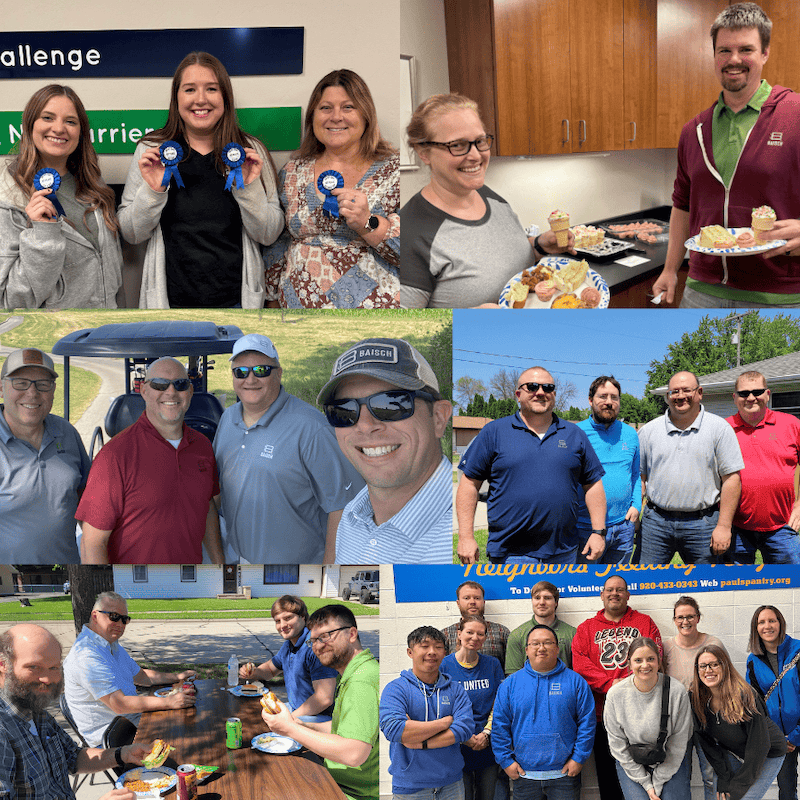
Download the file (9 MB MP3) Baisch Participates in Breast Cancer Awareness MonthFor each Baisch employee who wore pink on October 18, 2012, Baisch donated to the Breast Cancer Family Foundation of Green Bay, WI in recognition of Breast Cancer Awareness Month. It was Pink Pink Pink everywhere - tattoos, wigs, apparel, Baisch wrist bands, candy - for a very worthy cause!
Baisch’s Exterior RenovationInterview with Lee St. Aubin, AIA and Greg Kettnerof Baisch Engineering
Lee St. Aubin, AIABaisch Architect
Greg KettnerBaisch Architectural DesignerWhat was the inspiration behind the design?The design was inspired primarily by the image we want to present of our company. Before the new design, Baisch had a design that was somewhat reminiscent of the ‘80s. This was an era that brought about a lot of buildings that appeared to have been “manufactured”. Buildings at this point were commonly built with a “kit of parts” notion which often makes them appear to be somewhat cheap. This misconstrued design style was largely fed by the tail end of what we know of as the “modern” movement. In an attempt to get away from this “manufactured” sensibility we approached the new design using qualities of “permanence” and a sort of “powerful sophistication.” These qualities were presented with a healthy mix of more contemporary design techniques. To present the sense of “permanence” we kept materials that could stand the test of time, and added new materials that display that same sensibility. The stone on the front façade was the only material to remain. To this we added the brick finish. Because of the way the building was constructed as well as cost constraints, we could not use real brick, so instead we utilized a Dryvit EIFS (Exterior Insulation Finishing System) product. This product, known as Dryvit Brick, is a stucco based system that is applied over a brick template to simulate the look of real brick. The benefit of this material was that it was far easier to apply, far less expensive, and it gave us the added benefit of having more insulation on the building to regulate interior temperature and save energy. The ironic thing about this product is that, while it appears to be a permanent material, it is actually a product that will require varying degrees of maintenance over time, and thus it is like telling a little white lie with the architecture of the building. To present the concepts of “powerful sophistication” we employed a set of design principles from Architecture-101. This technique, mastered by Henry Hobson Richardson, uses a very simple set of rules to emphasize the base, middle, and top of the building. At the base of the building we applied the Dryvit Brick material, at the middle we applied quartz puts stucco finish, and at the top we placed a cornice that overhangs the building by about one foot to give the building a heavy, solid cap. An added benefit of the cornice was that it also gave us a place to install down-lights in the building for added security at night. The LED lights that we used provide a decreased maintenance cost as well as a substantial energy savings over traditional incandescent lighting. They are also far less obtrusive to the neighbors than the lights that we previously had. The last thing that we did to help add sophistication was to build out the corners of the building into pilasters. These subtle fenestrations in the building surface are a simple and well planned method to frame the façades of the building. Using this “base, middle, top” design strategy also adds to the “permanence” of the building because of the timeless nature of this design technique. Contemporary architecture often uses a variety of strategies to break up façades so the building does not seem too monotonous. To break up the facades here, we carried the brick finish all the way up the building wall at the stair towers. This creates visual interest through material changes as a person moves around the building as well as allowing the different parts of the building to read more easily. Ultimately, we are hopeful that the building will be able to stand the test of time for years to come. Landscaping - what can we expect to see in the spring?What you see around the building now is a more contemporary landscape design which was drawn up by Van Zeeland’s in Little Chute. This design uses a lot of native grasses and colorful bushes broken up with more vertical bushes and trees between the windows of the building. The red colored stone we had was replaced with a larger, dark grey stone to give some contrast against the building. The new plants were just recently put in place, and so they are still very young and under-grown. It is our hope that they will continue to fill out through next spring and summer, and that we will ultimately have a very attractive landscape to compliment the new building exterior. Did you use 3D at all in the design process? If so, how?Yes, we used 3D software to generate photo realistic images of the building during the day, at dusk, and at night from many different angles. These images really helped sell the design concept to the board. What is the material of the Baisch signage?A sign should really say something more about the business than merely the written words. The material is painted steel with a hammered bronze finish. We chose hammered bronze because of its intrinsic qualities such as strength, durability, perseverance, permanence, and professionalism; all positive attributes that describe Baisch. Do the LED down lights save any energy –in terms of a “green” concept?Greg: Fun math problem. There are 36 LED down-lights at 4 watts each totaling 144 watts. These lights replaced six 14 watt halogen up-lights and three 70 watt high pressure sodium door lights, totaling in the range of 294 watts. Ultimately, we more than tripled the number of lights and increased the quality of light while simultaneously using around 1/2 the amount of energy. Also, the LED lights that we used are rated to last 30,000 hours. In comparison to this, the standard life of the halogen bulbs is no more than 6,000 hours, and the life of the high pressure sodium lights is 24,000 hours. This means we are also saving on maintenance costs! How long did this project take?From the start of design to project close-out, took about a year, although we dragged our feet somewhat on the design phase as to coincide the start of construction with the beginning of summer. If you could have done anything different, what would it have been?Lee: Expanded the building, perhaps adding a third floor. As a firm, we could really use more space, especially a larger area where we can all meet in a large group setting without the inconvenience and distraction of having to leave the building. Greg: I generally try not to think of “could have, should have” scenarios, mostly because that’s a good way for an architect to lose a lot of sleep; however, if I could have done anything differently I think I might have given the brick a slightly deeper color with more brown tones. Also, I probably would have done a little bit more investigation around the parapet wall before they started pouring concrete which would have saved Don Jansen from acquiring a particularly messy office. What’s your favorite part of the renovation?Lee: Like any project that makes it past the drawing board and on to the construction phase, the best part is actually seeing your creation come to life after having looked at it for so long on paper and only being able to imagine what it might really look like. Greg: To my knowledge this was the largest application of Dryvit Brick north of Madison and Milwaukee. That being said, it does tickle my pride to have our building be used as a showcase project for a unique building system. What did you struggle with the most?Lee: The technical aspects of the Exterior Insulated Finish System (EIFS) material presented a challenge. The previous system we had on the building had failed in several areas due to water migration and penetration. Knowing how insidious and relentless water can be, we took a 2 pronged approach to detailing. First we detailed the wall system in such a manner as to prevent water entry, and second if the water did find its way in, that we had a means for it to escape before causing damage. Greg: As a young designer, I’d say the most unfamiliar part of the process to me was the close interaction with the contractors and the constant critiquing of their work. It was not something that I had any prior experience with and was a bit of a learning process for me. This challenge was compounded somewhat by the fact that we were working with a fairly uncommon material finish, which requires both the designers and contractors to think a bit outside their normal comfort zones. Which contractors did you use and for what?
Do you have a favorite architect? If so, who and why?Lee: Although he is not quite an architect, Greg is my favorite. On a serious note, favorite contemporaries include Michael Graves and Frank Gehry. Completely different styles, but I like them both. Greg: I do not have a favorite architect. The reason for this is simple. Famous architects often have a tendency to develop a god complex. They directly shape the world in which we live, and this gives them a degree of power. I have seen some of the best and some of the worse design concepts come directly out of this architectural sensibility. Because of this, I try not to focus on any single architect, but rather to learn from their collective successes and failures. Sporting Clays Anyone?Hi. I’m the Business Development & Marketing Manager for Baisch. I was born and raised in upstate New York –Rochester. Made my way to Boston, MA – lived there for 14 years. And, now I’m in Green Bay, WI. I love Wisconsin! It reminds me of home in upstate NY except the WI flat land, the somewhat milder winters (seriously!), and the numerous supper clubs. There is also another difference – the overarching passion for hunting, ice-fishing etc. all around me. Don’t get me wrong, upstate NY has its fair share of hunters. I have three brothers – one is a hunter, fisherman –an outdoorsy kind of guy –so, it’s not foreign to me by any means – it’s just… different. Different in the sense that I had no idea what Sporting Clay was until Lee St. Aubin, Baisch Architect, recently asked Baisch staff who would be interested in participating in a Sporting Clay event – through an industry professional association no less. I thought, interesting –and, wow, this would be perfect for me. Because, well, I have this feeling that I have a good shot, even though I’ve never even held a real firearm. So, my secret is out – desire to see if I’d be as good as I imagine I would be. But, regardless, I thought better of signing up for this Sporting Clay event seeing it wouldn’t be a smart move – a first-timer with seasoned Baisch Sporting Clay folks – yikes. Maybe next year for me. But, for this year’s Baisch participants – it was a GREAT event for them. Check out their picture – sheer happiness! Their sporting clay individual scores were:
192 out of 250 for a 0.768%! Way to go Baisch Team!
Baisch B-Fit Team Runs Fox Cities Relay Marathon
And, these lucky five runners also racked up some steps on their Baisch “B-Fit” Pedometer for the Baisch Step Challenge. Out of 60 employees currently participating in the challenge, Bob Van De Hey is at 1,495,928 with the most steps. Great job! Thanks for representing Baisch in this annual marathon, Team Baisch B-Fit!
More Articles... |
||
|
Baisch Engineering Inc. | 809 Hyland Avenue P.O. Box 440 | Kaukauna, WI 54130 | 920-766-3521 | This e-mail address is being protected from spambots. You need JavaScript enabled to view it. ![]() ![]() |